Lost Civilizations
The Lost City of Atlantis — Myth or Real Place?

Let’s be honest. Most of us first heard about Atlantis from a movie, a documentary, or maybe a video game. And most of us assumed it was just a legend — like dragons or the Loch Ness Monster.
But here is the thing. The story of Atlantis is not folklore passed down around campfires. It was written by one of the greatest thinkers in human history. And for over 2,000 years, serious people — philosophers, archaeologists, historians — have argued about whether it actually happened.
So what do we actually know?
Plato Wrote It. That’s Where It Starts.
Around 360 BC, a Greek philosopher named Plato wrote about a civilization called Atlantis in two of his works — Timaeus and Critias.
He described it as a powerful island empire located beyond the Strait of Gibraltar, out in the Atlantic Ocean. The Atlanteans were wealthy, technologically advanced, and militarily strong. They had built something remarkable.
Then they ruined it.
They became greedy and power-hungry. They tried to conquer Athens and expand across Europe and Africa. The Athenians pushed them back — but before anything else could happen, the gods stepped in. In a single day and night, Atlantis sank beneath the ocean. Just like that. Gone.
Now here is the first important question: why did Plato write this?
The Honest Case Against Atlantis Being Real
Most historians today will tell you plainly — Atlantis was invented by Plato. Not discovered by him. Invented.
Here is why that argument holds up:
Plato was a philosopher, not a historian. His writing was full of stories designed to teach moral lessons. The Atlantis story fits that pattern perfectly. A rich, powerful civilization that chose arrogance over wisdom and paid the ultimate price. It is a parable about what happens when a society loses its values. Plato had made that exact argument in other works too.
There is also the problem of evidence. Not a single record of Atlantis exists before Plato wrote about it. No Egyptian papyrus. No earlier Greek text. Nothing. For a civilization supposedly powerful enough to threaten Athens and conquer parts of Europe, that silence is difficult to explain.
And Plato himself presented the story as something passed down through generations before it reached him — a common technique ancient writers used when they were telling a story they had invented but wanted to sound credible.
Put all of that together and the conclusion seems clear: Atlantis was a brilliant piece of storytelling, not a history lesson.
But Then Again — Some Things Don’t Add Up
Here is where it gets interesting.
A growing number of researchers argue that Plato may have based the story on something real — a real place, a real disaster, distorted over centuries of retelling. And their evidence is not easy to dismiss.
The Minoan Civilization

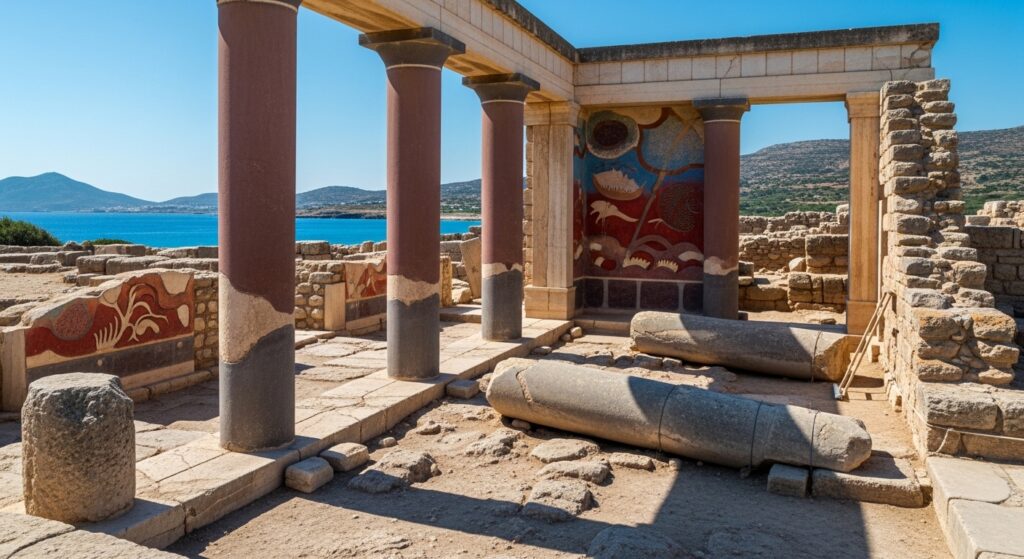
Around 1600 BC, one of the most advanced civilizations in the ancient world existed on the island of Crete. The Minoans were skilled sailors and traders who built sophisticated cities and dominated the Aegean Sea.
Then a nearby volcanic island called Thera — known today as Santorini — erupted. It was one of the most powerful volcanic eruptions in recorded history. The tsunamis that followed devastated coastlines across the region. The Minoan civilization never fully recovered.
Compare that to Plato’s story: an advanced island civilization, suddenly destroyed by a catastrophic event, disappearing from history. The parallels are hard to ignore.
The Numbers May Be Wrong
Some researchers believe the timescale in Plato’s account was mistranslated when the story passed through Egyptian records. Plato said Atlantis existed 9,000 years before his time. But if a translation error multiplied the number by ten, the actual date would be closer to 900 years before Plato — which lands almost exactly at the time of the Minoan collapse.
That is not proof. But it is not nothing either.
So Where Could Atlantis Actually Be?
Researchers have proposed locations on almost every corner of the planet. Here are the ones taken most seriously:
The Mediterranean — Sardinia, Cyprus, and the coast of southern Spain have all been proposed based on geography and ancient trade routes.
The Azores — These Atlantic islands sit on a volcanic ridge. Some researchers believe they are the peaks of a much larger landmass that sank thousands of years ago.
The Bimini Road, Bahamas — A formation of large flat stones on the ocean floor near the Bahamas. Some believe it is a man-made road. Geologists say it is natural. The debate continues.
The Richat Structure, Mauritania — This one has gained serious attention recently. The Richat Structure is a massive circular geological formation in the Sahara Desert, visible from space.
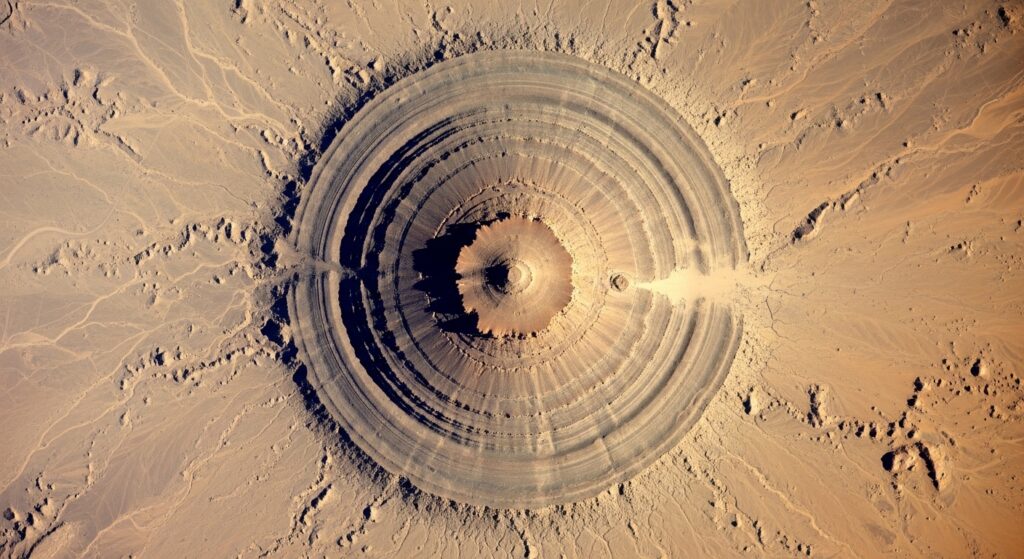
Its rings match Plato’s description of Atlantis’s circular layout almost exactly. Some researchers believe it was once a coastal site that has since dried out as the Sahara expanded. It is one of the most credible candidates discussed today.
None of these locations have produced definitive proof. But the fact that serious researchers keep looking says something.
Why Are We Still Talking About This?
Two thousand years is a long time for a story to survive. Especially one with no confirmed evidence behind it.
Part of the reason is obvious — the idea of a lost civilization hidden beneath the ocean is one of the most compelling mysteries imaginable. It taps into something very human. The belief that there is more to history than we know. That something important has been lost and might still be found.
But there is also a more grounded reason. History is full of places that were once considered myths until someone found them. Troy was dismissed as legend for centuries — until Heinrich Schliemann excavated it in 1868. The ancient city of Pompeii was buried and forgotten for 1,700 years before it was rediscovered.
Myths sometimes have real roots. That is what keeps the Atlantis question open.
Key Points
- Atlantis was first written about by the Greek philosopher Plato around 360 BC.
- He described it as a powerful island empire that sank into the ocean after its people became corrupt and tried to conquer the world.
- Most mainstream historians believe Plato invented Atlantis as a moral story, not a historical account.
- No record of Atlantis exists in any source before Plato.
- The strongest real-world candidate is the Minoan civilization, which was devastated by the Thera volcanic eruption around 1600 BC.
- The Richat Structure in Mauritania is one of the most discussed physical candidates for Atlantis today.
- No definitive proof of Atlantis has ever been found.
- Troy and Pompeii were both once considered myths — which is why some researchers refuse to close the book on Atlantis entirely.
Final Thought
Here is where we land. Plato almost certainly shaped and dramatized the story. It fits too neatly into his philosophical arguments to be pure coincidence.
But that does not mean it started from nothing.
The most likely truth is somewhere in the middle — a real catastrophe, a real lost civilization, filtered through centuries of retelling until it became something larger than history. A legend built on a foundation of fact.
Whether Atlantis is still out there, waiting to be found, or whether it only ever existed in Plato’s imagination — the story is not going anywhere.
And honestly? That might be exactly how Plato planned it.