Egyptian Mythology
The Real Story of Ra, Osiris, and the Egyptian Gods — And Why People Are Still Obsessed With Them

Most of us have seen the movie. The golden gods, the sand storms, the hieroglyphs carved into stone. But here’s the thing — Egyptian mythology is so much stranger, so much richer, and so much more human than any Hollywood blockbuster has ever shown you.
These gods didn’t just live in the sky. They had wars, betrayals, grief, and love. They died and came back. They lied to each other. They made mistakes. And the ancient Egyptians believed, with total certainty, that their gods were doing all of this every single day — just to keep the world alive.
Let’s actually dig into who these gods were, what they believed, and why millions of people today are still fascinated by ancient Egyptian mythology.

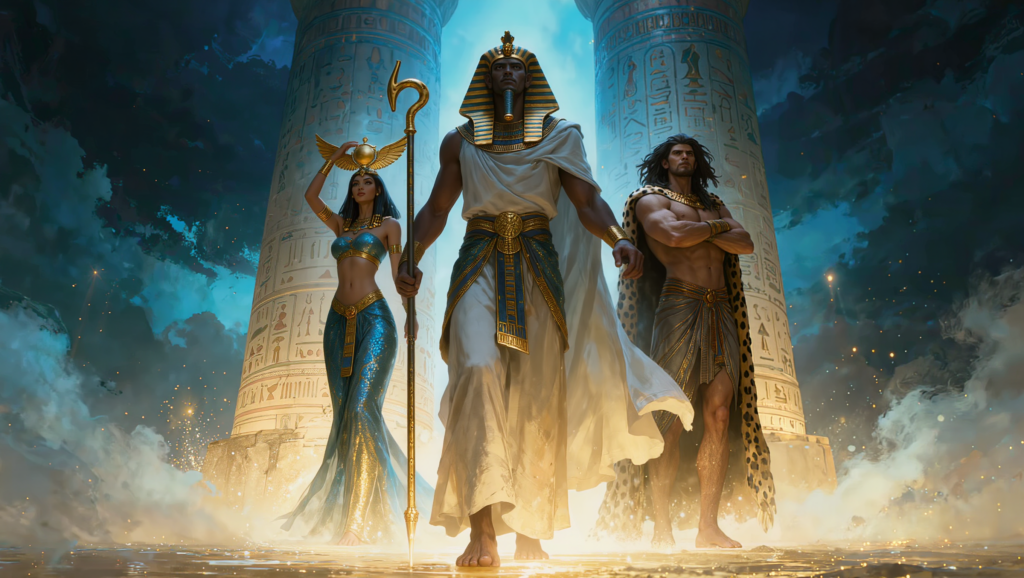
Ra: The God Who Had to Fight for the Sun Every Single Night
You’ve heard the name. Ra — the Egyptian sun god. But the version most people know stops there, at the name.
In ancient Egyptian belief, Ra didn’t just exist. He worked. Every single day, Ra sailed across the sky in his solar barque — a divine boat of light — pulling the sun from the eastern horizon to the west. That part sounds peaceful. What happened next didn’t.
Every night, Ra descended into the Duat — the Egyptian underworld — and had to fight his way through twelve hours of darkness, fending off a massive serpent named Apophis who wanted to swallow the sun whole and end the world forever. Ra won. Every night. And every morning, the sun rose again.
The ancient Egyptians didn’t take a sunrise for granted. To them, it meant Ra had survived the night — and the world had been given one more day.
Think about what that belief does to how you see a sunrise. It’s not just daylight. It’s proof that chaos was defeated, again, in the dark.
Osiris and Isis: The Murder Story That Shaped How Egyptians Thought About Death
If Ra was the engine of the living world, Osiris was the king of what came after it.
The story of Osiris is one of the oldest written mythologies on Earth, and it reads like a tragedy. Osiris was the rightful king of Egypt — beloved, fair, the one who taught humanity about farming, law, and civilization. His brother Seth was jealous. Not a little jealous. Murderously jealous.
Seth killed Osiris and scattered his body across Egypt in fourteen pieces, just to make sure he stayed dead. But Seth underestimated Isis.
Isis — goddess of magic and devotion, and Osiris’s wife — spent years tracking down every piece of her husband’s body. She gathered them, reassembled him, and used her magic to breathe enough life back into him to conceive their son, Horus. Osiris couldn’t return to the living world, but he became the ruler of the Duat — the first one who had died and passed through, now lord of the dead.
This myth wasn’t just a story to entertain people. It was the entire framework for how Egyptians understood death. Death wasn’t the end. It was a transition, governed by a god who had been through it himself.
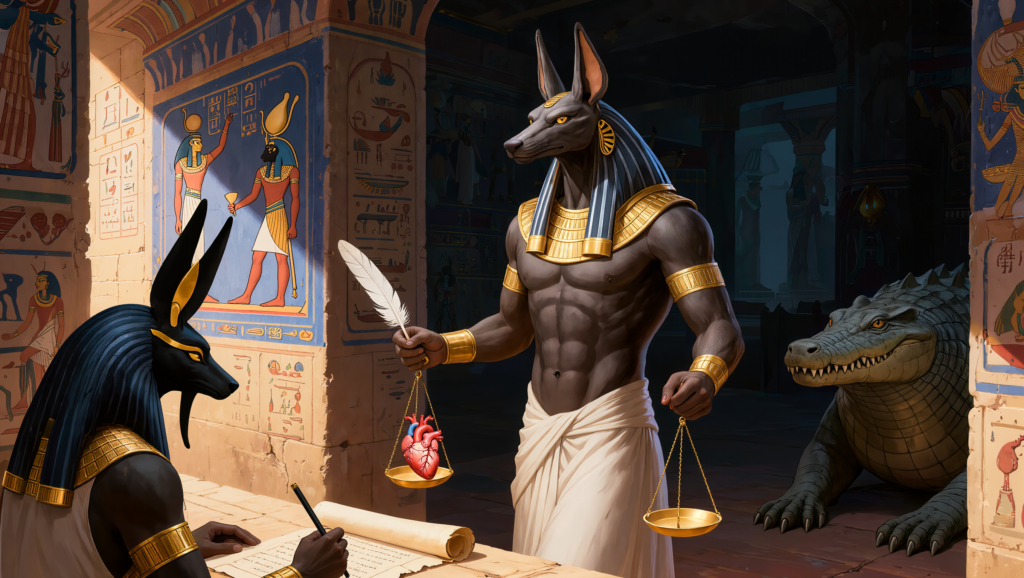
The Weighing of the Heart: What Actually Happened When You Died
Here’s where Egyptian mythology gets seriously detailed — and honestly, pretty compelling.
Ancient Egyptians believed that when you died, your soul made a journey to the Hall of Two Truths. There, Anubis — the jackal-headed god of the dead — would take your heart and place it on a golden scale. On the other side sat the Feather of Ma’at, the feather of truth and justice.
If your heart was lighter than the feather — meaning you had lived a good, honest, just life — you passed on to the Field of Reeds. The Egyptian paradise. A peaceful afterlife filled with everything you loved in the living world.
If your heart was heavier, weighed down by lies, cruelty, or wrongdoing — a creature called Ammit was waiting. Part lion, part hippopotamus, part crocodile. She ate the heart, and you ceased to exist entirely. No afterlife. No second chances. Just gone.
The god Thoth, scribe of the gods, recorded the result. Forty-two divine judges oversaw the whole thing.
This wasn’t a vague concept of heaven and hell. Egyptians had a specific, procedural afterlife with rules, witnesses, and consequences. The detail alone tells you how seriously they thought about how to live.
Horus vs. Seth: The Longest Fight in Mythology
After Osiris was killed and Isis raised their son Horus alone, one question hung over everything: would Horus ever reclaim his father’s throne?
The battle between Horus and Seth is one of the longest myths in Egyptian history — and depending on which ancient text you’re reading, it dragged on for eighty years. There were court hearings before the other gods. There were brutal physical fights. There was strategy, trickery, and moments where it genuinely wasn’t clear who would win.
In the battle, Horus lost his left eye. Eventually, Horus won. He became ruler of the living world. Seth was exiled to the desert. And the Eye of Horus became one of the most recognizable symbols in all of human history — a symbol of protection, royal power, and healing.
Every pharaoh who ever ruled Egypt claimed to be the living embodiment of Horus. When they died, they became Osiris. The mythology wasn’t separate from Egyptian politics — it was woven directly into who held power and why.
Why Egyptian Mythology Still Matters Today
Here’s the honest answer: it matters because it’s one of the most complete pictures we have of how an ancient civilization understood existence.
Egyptian mythology wasn’t a collection of random supernatural stories. It was a structured worldview — a cosmology that explained where the world came from, why the seasons changed, what happened after death, and what it meant to be a just person. Every major festival, every temple ritual, every hieroglyph carved into stone was part of maintaining that world.
And the gods themselves were complicated in a way that still resonates. Ra fought for the world every night and sometimes lost battles along the way. Isis was brilliant and powerful and also devastated by grief. Osiris was the most righteous king Egypt ever had and still got murdered. Horus grew up without his father and spent decades fighting for something that should have been his from the beginning.
These aren’t flat divine beings handing down commandments. They’re characters living through something — and the ancient Egyptians who told their stories understood that even the gods had to struggle to keep the world in order.
Maybe that’s why, five thousand years later, we still can’t stop talking about them.
weighing of the heart, Egyptian Book of the Dead, Anubis god of the dead, Eye of Horus meaning, Apophis serpent, Ma’at feather of truth, ancient Egyptian religion, Egyptian gods explained, Duat Egyptian underworld